
Why Surface Preparation Remains the First Line of Defence
Corrosion affects almost every industry that relies on steel assets. Whether it is a refinery, a shipyard, a power plant, a pipeline network, or a fabrication facility, the challenge remains the same: protecting critical infrastructure from gradual deterioration.
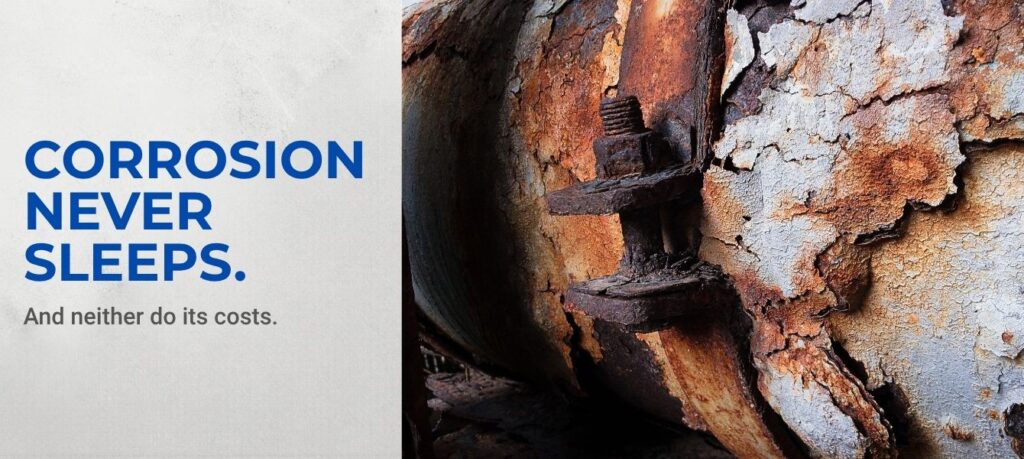
The challenge is that corrosion rarely starts as a major problem. It often begins as a small rust patch beneath a coating, a weakened section of pipe, or a deteriorating steel surface. Left unchecked, these issues can develop into costly repairs, unplanned downtime, safety concerns, and premature asset replacement.
The Global Cost of Corrosion
The economic impact of corrosion extends far beyond maintenance budgets.
Globally, corrosion costs industries an estimated US$2.5 trillion every year, roughly 3.4% of global GDP. However, studies by AMPP indicate that 15–35% of these losses could be avoided through more effective corrosion-control practices.
These costs are distributed across virtually every stage of an asset’s lifecycle. They include equipment replacement, emergency maintenance, production losses, reduced efficiency, labour costs, inspection requirements, and operational downtime.
For industries that rely heavily on steel infrastructure, corrosion is not simply an engineering issue. It is a business issue.
A single unexpected shutdown can disrupt production schedules, delay projects, impact profitability, and create safety concerns. In industries operating under demanding conditions, even small instances of corrosion can have consequences that extend well beyond the affected component.
The most successful organisations understand that corrosion prevention is rarely about reacting to failures. It is about creating systems and practices that prevent those failures from occurring in the first place.
More Than Maintenance: The Sustainability Impact
The conversation around corrosion has evolved significantly in recent years.
Historically, corrosion was viewed primarily as a maintenance challenge. Today, organisations are increasingly recognising their environmental implications as well.
Every time a steel asset fails prematurely due to corrosion, the cycle begins again. New raw materials, new manufacturing, new transport, and new emissions. Research published by Nature found that replacing corroded steel could account for 4.1% to 9.1% of global climate targets by 2030 if left unmanaged.
This statistic highlights an often overlooked reality: corrosion does not simply consume maintenance budgets. It also consumes resources.
Premature asset replacement requires additional steel production, transportation, installation, energy consumption, and waste management. Each of these activities carries an environmental cost.
As industries pursue sustainability goals and seek to reduce their environmental footprint, extending the life of existing assets has become increasingly important.
In many cases, the most sustainable asset is not a newly manufactured one.
It is an existing asset that continues to perform reliably for years beyond its expected service life.
Effective corrosion prevention, therefore, contributes not only to operational performance but also to resource efficiency and long-term sustainability.
Understanding Industrial Corrosion
Corrosion is the natural deterioration of a material, typically metal, caused by chemical or electrochemical reactions with its environment.
Steel, despite its strength, versatility, and widespread use, remains particularly vulnerable when exposed to moisture, oxygen, salts, chemicals, and industrial pollutants.
Industries operating in coastal environments, marine applications, refineries, chemical plants, offshore installations, and heavy industrial facilities face even greater corrosion risks due to the aggressive nature of their operating environments.
While each type of corrosion behaves differently, the outcome is often the same.
- Reduced asset reliability
- Increased maintenance requirements
- Shortened service life
This is why corrosion management must be approached proactively rather than reactively.
Why Surface Preparation Matters
Many corrosion problems are blamed on coating failure.
In reality, the root cause often lies much deeper.
Protective coatings are designed to act as a barrier between an asset and its environment. However, for that barrier to perform effectively, it must be applied to a surface that is clean, properly prepared, and capable of supporting long-term adhesion.
When contaminants such as rust, mill scale, old coatings, or surface residues remain on the surface, the coating’s ability to protect the asset can be compromised from the very beginning. The result may not be visible immediately, but over time it can lead to premature coating breakdown, increased maintenance requirements, and a shorter service life for the asset.
This is why surface preparation is considered the foundation of effective corrosion control.
Industry studies suggest that a significant proportion of coating failures can be traced back to inadequate surface preparation. In many cases, what appears to be a coating problem is actually a surface preparation problem.
Long-term corrosion protection is not determined when rust becomes visible.
It is determined much earlier, before the first coat is ever applied.
The earlier protection begins, the greater the long-term return.
And that begins at the surface.
The Role of Abrasive Blasting in Corrosion Prevention
For decades, abrasive blasting has remained one of the most effective methods of preparing steel surfaces for protective coatings.
The process removes rust, corrosion products, mill scale, old coatings, and surface contaminants while creating the required anchor profile for coating adhesion.
This profile enables coatings to bond securely with the substrate, improving long-term performance and reducing the likelihood of premature failure.
The benefits of proper abrasive blasting include:
- Improved coating adhesion
- Extended coating life
- Reduced maintenance frequency
- Better asset reliability
- Lower lifecycle costs
- Improved corrosion resistance
For industries where asset reliability is critical, abrasive blasting is not simply a cleaning process.
It is the foundation upon which effective corrosion protection is built.
Building Protection Before Damage Appears
Corrosion may be inevitable.
Premature asset failure is not.
Organisations that prioritise inspection, surface preparation, coating integrity, and proactive maintenance consistently achieve lower lifecycle costs, longer asset life, and improved operational reliability.
The most effective corrosion-control strategies do not begin when rust becomes visible.
They begin much earlier, with decisions made during surface preparation and asset protection planning.
At Blastline India, we believe corrosion prevention should begin before corrosion does. Through reliable abrasive blasting equipment and surface preparation solutions, we help industries create the foundation for stronger coating performance, longer asset life, and more sustainable operations.
Because corrosion never sleeps.
And the businesses that act early are the ones that lose less.